Wednesday, May 20, 2015

Sea Urchin Spine Necklace


Last week my friend Brooke Bock, of Artistic Endeavors 101, sent me a wonderful gift... a box of beautiful handmade polymer clay beads. Opening the package was like opening a treasure chest, brimming with beautiful baubles. Her polymer clay beads have a fabulous finish, with the look and feel of porcelain. Her thoughtful gift was the inspiration for this necklace.

Brooke made the focal bead and the 5 supporting disc beads on the lower left. As soon as I saw them I knew what I wanted to make.

I had been saving the sea urchin spine for years. It was not drilled, and I wasn't sure how to approach that task. I decided to use my drill press. At first I worried that the delicate spine would shatter, so I approached the task very carefully. It turns out that drilling holes in sea urchin spines is a fairly easy process, much like drilling wood or metal. Going slowly is the key.


To complete the necklace I used faceted quartz beads, in a pinkish brown color, and a handful of vintage African horn beads, rescued from a thrift store. I used 20 gauge black annealed steel wire from Susan Lenart Kasmer's wire collection to make the bead connectors and clasp. The wire can be purchased here:


Brooke sells her lovely beads in her etsy shop:


I am excited about incorporating more of Brooke's inspiring beads into my designs. 

Until next time!

Leaving you with this quote:
"Friendship is born at that moment when one person says to another, 'What! You too? I thought I was the only one' - C.S. Lewis


Tuesday, May 12, 2015

Recycled Bullet Shell and Cookie Tin Earrings

Whenever I go hiking I keep an eye out for bullet shell casings. They come in all sizes, and can be recycled into jewelry-making components.


I love that I used so many reclaimed components to make these. I found the bullet shell casings when we went to southern Oregon on a camping trip. The tin was a gift from a friend. It was full of Key Lime Cooler cookies. After we ate all the cookies, of course I saved the tin. I love the combination of stripes and checkers. 

For these earrings I used a pipe cutter from the hardware store to cut off the bottoms of the bullet shell casings. I used a drill press to put holes in them. A hammer and nail will work on most casings, but I've found that some do need to be drilled out. Next I cut two metal pieces from a cookie tin, filed the edges smooth, and wrapped the tin around the casings, securing them in place with a drop of E6000. Finally, I wired them up with headpins, small frosted black glass beads, green jade beads, crystal spacers and then topped them with more black glass beads.

The crystal spacers were antiqued with Jax Pewter Black and then sealed with Dorland's Wax. Here's where you can buy the Jax:


...and here's where I found the sterling ear wires:

This is a really fun easy project, and they're fun to wear too.

Until next time!

Leaving you with this quote:

"Enjoy NOW like a child and pursue the future like a BULLET." - Colin Wright

Wednesday, May 6, 2015

Easy Staple Bezel And Glass Marble Earrings

Last week I was tidying up my studio and I ran across a couple of small Susan Lenart Kazmer staple bezels that I had in my stash of findings. Sometimes bringing a new set of eyes to familiar findings is such a good thing. As I looked at the shape of the bezels, I thought of my small drawer of marbles and glass globs. Whenever someone sends me flowers, I save the little round glass pebbles that they use to weight the bottom of the vase. I remembered some pretty iridescent pink and pale blue ones. Would they fit?


They did! They were really easy to make. Here's how:  For the pink earrings, I used a the antique bronze staple bezels. They are really easy to use, all you have to do is fold the prongs around the marbles. 

You can buy the staple bezels at http://stampington.com/the-shoppe-at-somerset

It helps to use two pairs of chain-nose pliers and to steady the marble on the table while you are working. I cut two 2" pieces of craft that wire my husband bought for me. He's a nice guy. They came in a package and didn't say the gauge, but I'd have to guess they were somewhere around 16 gauge. I bent the ends with my stepped pliers, using the smallest setting, then I used my bail forming pliers to make the earwires out of 20 gauge brass wire. My ears are not sensitive at all, so brass, copper... anything works for me. For sensitive ears, pre-made niobium earwires work really well. 


After I finished the pink ones, I made a second pair. This time I used the white bronze staple bezels and blue marbles:


For the long pieces, I used anodized steel 18 gauge wire from the hardware store. I used my coiling tool to make some little silver-plated 24 gauge coils to slip over the wires, to make them look a little thicker. I finished by making earwires out of 20-gauge silver-plated wire.

This is a fun little project, super easy to make, and it gives you a chance to use up all those little glass bits you've been hanging onto!

Until next time!

Leaving you with this quote: "Nobody move, I've lost my marbles!" (Or maybe in this case, I've found them!)


Saturday, May 2, 2015

Making A Mason Bee Motel

Okay, this isn't my usual jewelry-related project, but I'm super-excited about this and wanted to share it with you. I am one of those people who puts bugs outside, instead of squishing them. Especially bees. In the spring and summer, when we have a few doors and windows open, I keep a tiny clear jar and a piece of stiff cardboard handy. If a bee wanders inside and can't find its way back out, I catch it in the jar and put it back outside. Lately I've been noticing some bees I haven't seen before. They are smaller than honey bees, and were very gentle when I was trying to save them, not aggressive at all. I did a little research and discovered they are a native species of mason bee. They are fabulous pollinators, and one mason bee can pollinate as many trees as 100 honey bees. They live in holes in wood, but are incapable of making their own holes. One website suggested welcoming them by building bee boxes. I got really excited about the idea. This morning my husband and I made 5 of them.


They were really easy to make. Here's how we did it: We had some leftover post ends from a barn-related project. They were 8 1/2 inches long, and measured 3 1/2 inches square. If you're buying them, they call them  4-by-4's, because that's the size they are when the wood is still wet. It shrinks as it is kiln-dried. We also had some old cedar shingles that we had used to repair the old roof, before we replaced it with a metal one. We sawed the shingles in half and drilled a small hole in the center of each one. For the holes in the wood, where the bees will live, we used a 5/16 inch drill bit. We marked the holes so that they would be at least an inch apart, and drilled them with the drill press. From what I could find out, it didn't really matter if the holes went all the way through or not because the bees would be using mud to block the entrances. No problem there... we live in the Pacific Northwest and mud is plentiful! We attached the roof shingle to the motel with an eye screw and hung each one from a tree. Mason bees apparently like east-facing holes, because they are cold-blooded and need the sun to warm them up in the morning. They also need places that are somewhat sheltered to the wind. We hung a few of them in our apple and pear trees, one in a rhododendron bush, and bolted one to the fence by the raspberry plants. Now we wait. 

With the recent decline in honey bees nation-wide, it seems like giving these little native pollinators a place to live is a really good idea!

Until next time!

Leaving you with this quote: "When the flower blossoms, the bee will come." Hopefully when the bee house is put in the tree, the same thing will happen!

Friday, May 1, 2015

Home At Last Earrings

I'm home now, but I lived about as far away from here as I could possibly have, without leaving the country, that is. Born and raised in Washington State, in a suburb of Seattle, I spent 11 years living in Central, East Coast Florida. While I loved the palm trees and the warm ocean, I was homesick the entire 11 years.

I remember reading somewhere that every animal has a habitat, even people. I used to wonder if maybe I was like a salmon, yearning to return to my place of birth. I live so close to my birthplace now that I actually know the people who own the house my family owned when I was born! I've been home for almost 9 years now, and I am thankful every day.

With that feeling of thankfulness, I set out to make these earrings.


I call them "Home At Last" earrings, and they are made from air-dry paper clay and copper wire.

Here's how I made them:  First I rolled out the paper clay with a rolling pin and cut out two house shapes with a craft knife. I then used the knife to make the outline of the roof line, slicing the clay only about halfway through. Then I found a little piece of metal that had a rectangular shape and stamped the doors and windows into it. I poked a piece of 20 gauge copper wire into the clay and let it dry for three days. Then I put Mod Podge onto the surfaces and dusted the houses with pastel-toned Pearl-Ex powders, finishing them with a top-coating of more Mod Podge. For the circles, I used a chasing hammer on the 18 gauge wire and wrapped it three times around a round handle, finishing by wrapping the tails around the larger circles. Then I made the wrapped loops at the tops of the houses, attaching them to the copper circles. I finished with vintage flowers, puffy hearts and antique copper french earwires. 

It certainly does feel good to be home at last, and wearing these earrings reminds me never to take that feeling for granted!

Until next time!

Leaving you with this quote:  "There is nothing half so pleasant as coming home again." Mary Elizabeth Sangster


Thursday, April 30, 2015

Bracelet Made From A Vintage Dog Cookie Cutter

I remember my Mom making cookies every Christmas... tins and tins of them, which she would give away to friends and relatives. My favorites were always the sugar cookies and the gingerbread men, because she would roll out the dough and I would get to use the cookie cutters. Happy memories. I have a small collection of tiny vintage cookie cutters. I wanted to find a way to use them in a project.

I love giving myself a recycling challenge. One of my favorites is to see if I can make a piece of jewelry using a minimum number of new findings. That's how this little cookie cutter bracelet came to exist. 


To make this bracelet, I started with a tiny aluminum cookie cutter. The poor thing had been squished and was a little flat to begin with. No worries though, this made it the perfect surface to which to adhere a red "self starter" typewriter key. A couple of drops of E6000 and it was all set to go. I used a metal hole punch to punch a hole in each end, and attached a toggle from an old handbag and pieces from a thrift store chain. I made the bead dangles from reclaimed beads as well. In the end, I added 5 new jump rings and 4 new headpins.I found both at yadannabeads.etsy.com. Everything else was made from vintage or recycled components. 

I'm not sure how certain pieces become "keepers" for me, but this one has. It's fun and quirky and I really enjoy wearing it.

Until next time!

Leaving you with this quote:
"Nothing is more effective than sincere, accurate praise, and nothing is more lame than a cookie-cutter compliment." - Bill Walsh
(Actually, if I were wearing this bracelet, I would be thrilled to receive a cookie-cutter compliment.)


Wednesday, April 29, 2015

Concrete and Ice Resin

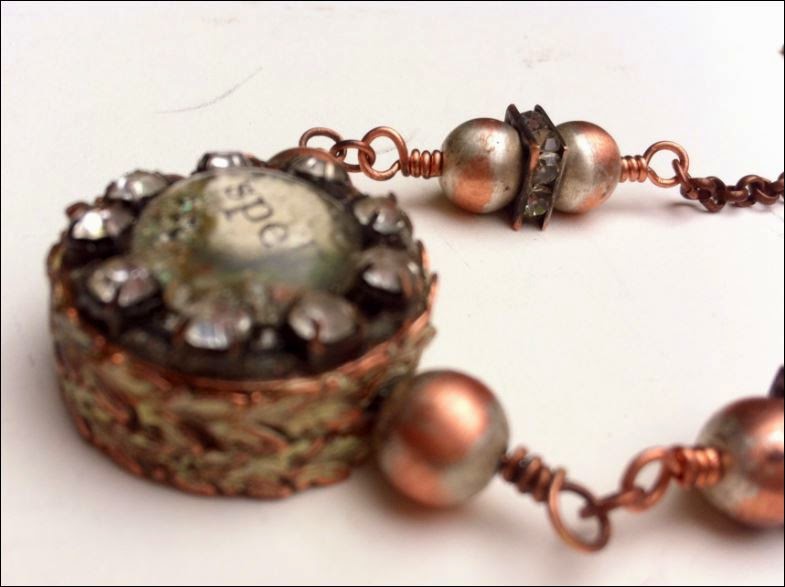
Who knew? I didn't. One of the ways to strengthen concrete is by mixing it with a two-part resin. Mr. Bees was doing an outdoor project and asked me if I wanted the leftover concrete. Of course I wanted it! After a little research on the subject, I discovered that concrete, by itself, tends to crack, and is unsuitable for jewelry-making, but when you add a little 2-part resin to the mixture, it becomes very strong. I happened to have a syringe of Ice Resin handy, so I used that, instead of water, to make my concrete.

I've been working on a series of fairy tale pieces, so the word "Spell" popped into the foreground for me.


Here's how I did it... I used my pipe cutter to cut a slice of copper pipe, punched holes into it, and used plumber's solder to solder the pipe onto a pre-cut round piece of copper sheet metal.There was lots and lots of filing, then I filled the bezel with a mixture of concrete and Ice Resin. 

You can purchase tubes of Ice Resin and Relique powders here: http://stampington.com/the-shoppe-at-somerset.

After it set up for a couple of hours, I dropped Relique powder and extra fine glitter onto the surface and heated it with a heat gun. The Relique powder melted and adhered the text, glass piece, and rhinestones to the surface of the concrete mixture. The concrete shows through, but the Relique powder makes it look like some sort of stone. By morning the whole thing had set up quite nicely. I added decorative bezel wire to the border, antiqued it, first with cream-colored Vintaj patina and then with Jax Pewter Black, used a little steel wool on it, and finished by sealing it with Dorland's Wax. 

The beads were very grungy silver plated copper, salvaged from an old necklace. A little steel wool coaxed them into having a much nicer finish. 


Whenever I use my fingers in a photograph, I notice that they are always full of tiny cuts and pokes and jabs from the file. It's all just part of getting lost in my work.


I really like this patterned copper bezel wire. I found it on eBay. It came from Israel, and I had to wait months for it to arrive, but it was worth the wait!


I saved a small coffee can of concrete for more experiments. Next I want to try making some more contemporary, backless forms with the mixture.


Until next time! 

Leaving you with this quote: 

"Art is the concrete representation of our most subtle feelings." - Agnes Martin
(In this case, maybe concrete is the artistic representation of mine.)